Geometries of Attention
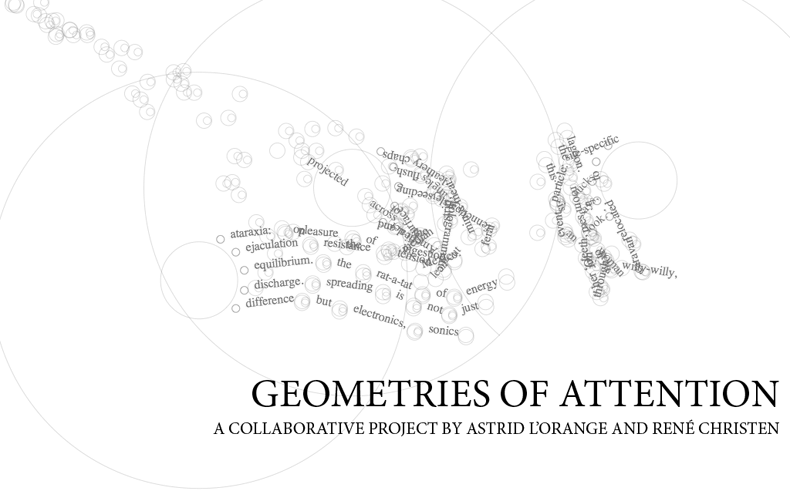 Originally, this collaboration began with the pleasing realisation that the vocabularies of poetics and code overlapped significantly; pointing at times to companionable and at times different compositional, spatial, philosophical and practical functions. The potential for the language of poetics and the language of code to work productively and generatively into their differences and sameness, repetitions and dead-ends, was great.
More importantly, we shared a crucial idea: that without engaged attention, without interaction, without invested play, interrogation and investigation, there is no experience of the world and its things. To think and to play – to think about thinking and to play with play – are central to our engagement with and understanding of the world. It is an ongoing, almost unintelligible process; subject to change and chance. When we are attentive to our negotiation with these processes, we realise that we are continually producing and collaborating with the materials of experience.
The three works in this collection ‘happen’ when they are touched, moved and played with. A poem ‘happens’ when it is read, when its language is performed in the event of reading or listening. We invite everyone to tune their attention, to make it ‘happen’.
Geometries of Attention is supported by the Australia Council for the Arts’ Emerging Writers/Illustrators Initiative.
Many thanks and acknowledgments to Ernst and Marianne Christen for their invaluable help, and a big thank you to Tom Smith for assistance in recording the sound files. With much love and appreciation for the Serial Space Gallery and its directors.
Table
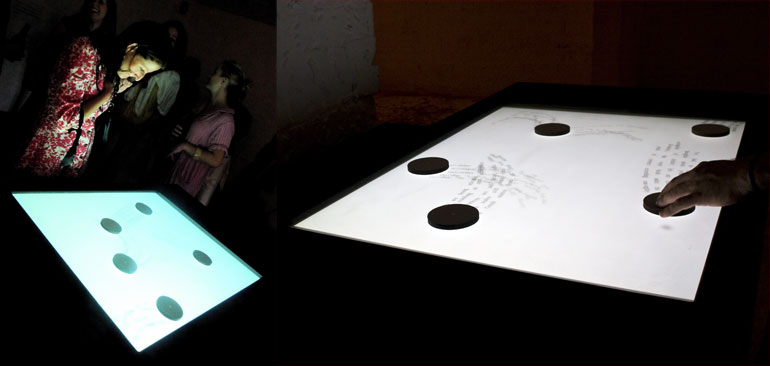
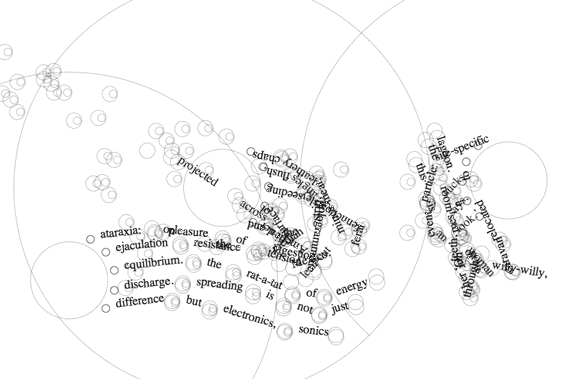
A tabletop is also a projection surface. There are five small wooden discs. Any disc may be on the tabletop at any time: alone, in a group or all together. When placed on the tabletop, a five-line poem will animate onto the projection surface, attached to a disc.
When two poems encounter each other, they will have a relationship. There are dynamics of attraction and dynamics of repulsion. There are intimacies and retreats. Any relationship will be the material for another poem; each poem transform after encountering another. As the discs are moved onto and off the surface, slid into and away from each other, poems happen and un-happen, are written and change.
The text for these poems was generated after and because of the early atomic theories of Epicurus and Democritus, and in great appreciation of Lucretius’ epic poem ‘On the Nature of the Universe’. Lucretius’ poetic dealt specifically with the push and pull of all things.
Wall
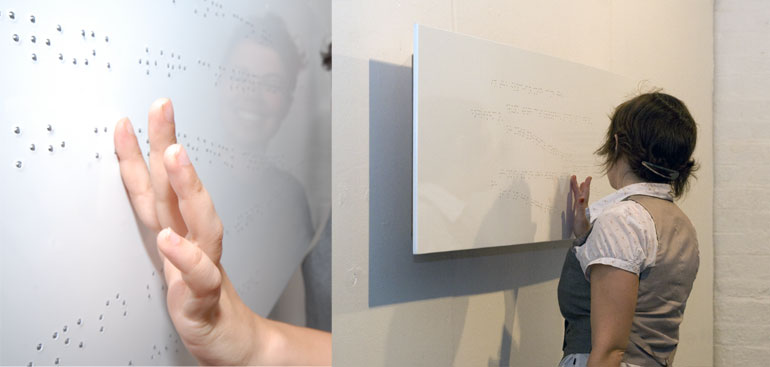
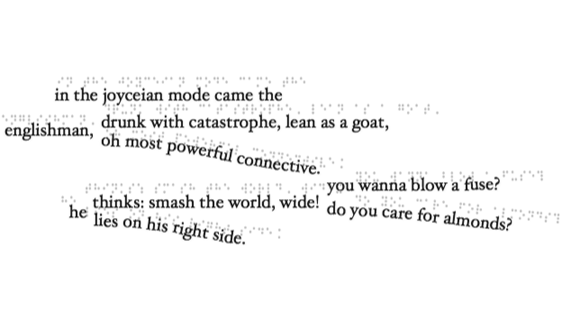
A short poem is written in forked syntax so that it may be read in a number of ways. The poem’s text is transliterated into braille. Each node of braille is the nub of a rivet. Touch is detected by sending small electrical currents through these nodes: the frequency is amplified by the body and returned back to system; the current is sent out one node, through the finger, and back into another.
As fingertips travel across the wall, a poem’s sound is generated. This sound-poem is a longer version of the text on the wall. The short poem indexes the long poem. The wall is felt and variations of the same poem are generated. (A poem is a collection of many potential other poems.)
The text for the Wall was composed using William Carlos Williams’ epic poem, ‘Paterson’ (itself a cut-up, of sorts) as a source text. Each word in the Wall appeared in ‘Paterson’. The poem is a playful response to Williams’ well-known poetic dictum no ideas but in things, which was often realised in acute imagery and visual metaphor. The language of this composition gestures at non-visual and non-imagistic thingliness.
 Radio
Radio
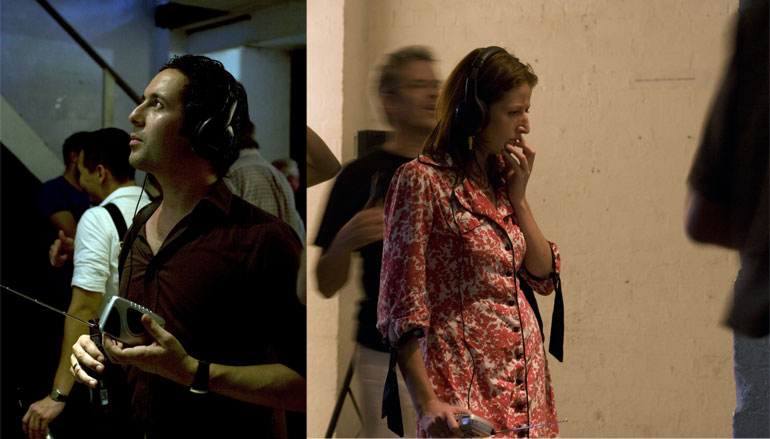
Four audio channels broadcast a poem from four different FM transmitters hidden in the room. Each is transmitted on the same frequency. Any one can take a receiver, tuned into the frequency, and explore the radio signals in the space. As one moves through the room, fragments of the poems will emerge, bloom and fade; corrupting and obfuscating each other or producing the material for a disharmonic soundscape.
The four poems: ‘A Parasite’, ‘Lovetypes’, ‘Philadelphia’ and ‘A Bluecoat’, were composed from the collected archival of six months reading and writing. The language of Michel Serres, Gertrude Stein, Alfred North Whitehead, Erik Satie, John Cage, Jackson Mac Low, Kurt Schwitters, Lyn Hejinian and many others – including email correspondents – have been co-opted, interfered with, grafted and reterritorialised.
Geometries of Attention premiered at Serial Space gallery in Sydney and was supported by the Australia Council for the Arts’ Emerging Writers/Illustrators Initiative.